Driving in Chiang Mai is manageable once you understand the local conventions and stop trying to apply home-country driving logic to Thai roads. The city is slower-paced than Bangkok, the road network is readable, and most roads are in reasonable condition. What trips people up is not the infrastructure but the behavioural norms of Thai traffic, which differ significantly from what most Western drivers expect.
This guide covers the practical realities of driving in Chiang Mai for someone new to the city: the rules that matter, the conventions drivers actually follow, and the specific situations that cause problems for newcomers.
Left-Side Driving
Thailand drives on the left. Steering wheels are on the right. If you come from a country that drives on the right, every overtaking manoeuvre and every roundabout will initially feel wrong. The adjustment typically takes two to three days of focused driving to become natural. Give yourself time in low-traffic conditions before attempting complex junctions or mountain roads.
Speed Limits and Enforcement
City speed limits in Chiang Mai are typically 80 km/h on major roads and 40 to 60 km/h on smaller roads and in residential areas. Fixed speed cameras exist on several major routes. Mobile radar units operate at various locations. The most significant speed enforcement tends to be on routes out of the city toward Lamphun, Hang Dong, and the Superhighway.
In practice, traffic rarely moves at the posted limit in city areas during the day. The real risk is on stretches of open road where the limit is 90 km/h and the enforcement is occasional but real.
Intersections and Traffic Signals
Red lights in Chiang Mai are widely observed at major intersections. Smaller intersections often use yield rules where the larger or faster-moving stream of traffic has informal priority. The dangerous intersection behaviour to watch for is:
- Late red-light running: Vehicles entering an intersection as the light turns red is common. Do not accelerate immediately on green. Wait two seconds and check both directions.
- U-turns from inner lanes: Thai drivers make U-turns from inside lanes across all lanes of traffic. This is legal at designated U-turn points and often happens informally at others. Stay alert near median gaps.
- Motorbikes between lanes: Motorbikes filter between lines of slow traffic and are often in your blind spot. Check mirrors constantly in slow traffic.
The Moat Road
The road around Chiang Mai's Old City moat runs one-way in sections. The convention is anticlockwise around the moat. First-time drivers sometimes enter a one-way section in the wrong direction because the signage is not always obvious. If you are uncertain of the direction, observe the parked car orientation or follow other vehicles for a block.
Mountain Roads Around Chiang Mai
Routes into the mountains (Doi Suthep, Doi Inthanon, Mae Hong Son direction, and Pai) involve significant elevation gain, hairpin corners, and road surfaces that change with rainfall and season. For motorbike riders especially, mountain roads require a higher skill level than city streets. Descending steep roads on a rented scooter in wet conditions is genuinely dangerous. Take mountain routes slowly, use both brakes smoothly, and assess road conditions before committing to a descent.
Parking in Chiang Mai
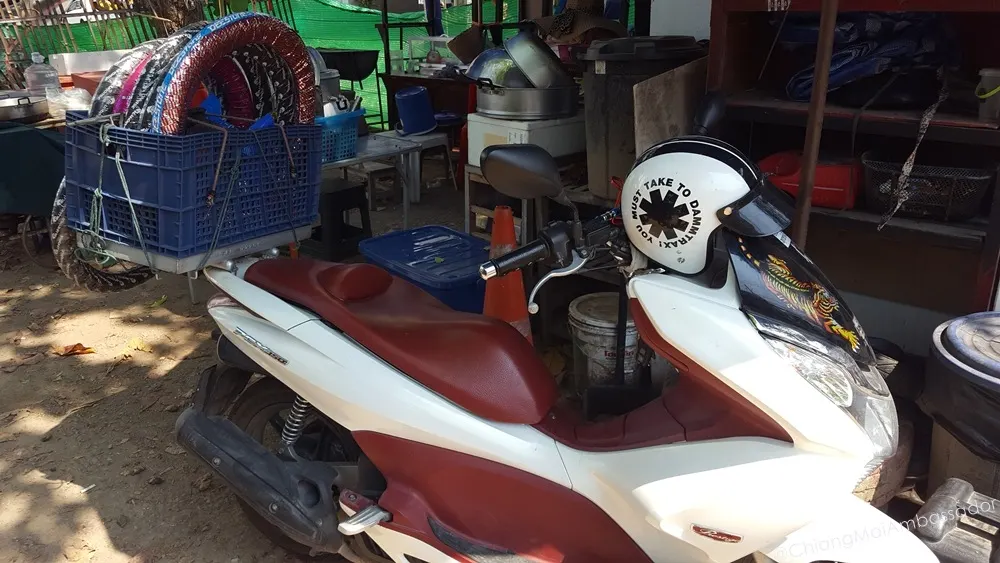
Parking in central Chiang Mai is manageable for motorbikes (which can park on pavements and at the edges of carparks at no cost in most areas) and more challenging for cars. Paid parking is available at malls (Maya, Central Festival, Central Airport), some hotel carparks, and at metered street spaces. Parking enforcement exists on the main roads. Motorbikes in most areas can be left at kerbs without issue.
Driving Licences
A valid Thai driving licence or an International Driving Permit (IDP) from your home country is required to legally drive in Thailand. An IDP is valid for 90 days from entry. After 90 days, or if you are a long-stay resident, a Thai licence is the correct route. The process for obtaining a Thai car or motorcycle licence at the Chiang Mai Land Transport Office is covered in the driving licence guide on this site.
Driving or riding without a valid licence voids your insurance coverage. This is not a theoretical risk to ignore.
Road Conditions and Hazards
Main roads in Chiang Mai city are generally well-maintained. Side streets (soi) vary considerably. Specific hazards to be aware of:
- Road surface changes: A smooth section of road can transition to potholed or uneven surface without warning, especially on outer ring roads and mountain routes.
- Street dogs: Dogs crossing roads and sleeping on road edges are common, especially at night. A dog running in front of a motorbike is a genuine accident cause.
- Flooding: During heavy rain (June to October), low-lying roads flood quickly. Check ahead before driving into standing water of unknown depth.
- Agricultural vehicles: On routes south and east of the city, slow-moving agricultural vehicles on the road are common in the morning and late afternoon.
Key Takeaways
Key Takeaways
- Drive on the left. Steering wheel on the right. Allow 2 to 3 days to adjust if from a right-hand-drive country.
- Always wait after green lights. Late red-light running is the most dangerous intersection hazard.
- Mountain roads require real riding or driving skill. Do not attempt steep mountain descents on a small scooter in wet conditions without experience.
- A valid Thai licence or IDP is legally required. No valid licence means no insurance coverage.
- Emergency numbers: 191 (police), 1669 (ambulance).
Frequently Asked Questions
Is driving in Chiang Mai safe?
Manageable with the right approach and realistic expectations. Chiang Mai is significantly calmer than Bangkok. The main risks are late red-light runners, unexpected U-turns and lane changes, wet road surfaces, and mountain road hazards. These are all predictable once you know to watch for them. Defensive driving, appropriate speed, and not riding beyond your skill level on mountain roads reduces risk significantly.
Can I use my foreign driving licence in Chiang Mai?
For the first 90 days of a trip, an International Driving Permit from your home country is accepted. For stays beyond 90 days, a Thai driving licence is the legal requirement. Some nationalities can convert their home licence more easily than others. Check the Chiang Mai Land Transport Office process via the driving licence guide on this site.
Do I need to wear a helmet in Chiang Mai?
Yes. Helmet use is legally mandatory for motorbike riders and passengers in Thailand. Police checkpoints enforce this and fines apply. Practically speaking, a helmet is also the piece of safety equipment that most reduces injury severity in an accident. Buy or rent a good one.
What should I do if I am pulled over by police in Chiang Mai?
Pull over safely, turn off the engine, and stay calm. Have your licence, vehicle registration, and insurance documents accessible. Be polite and do not argue. If you do not speak Thai, say "Phoot Thai mai dai" (I cannot speak Thai). Fines for common infractions like expired registration or no helmet are typically 200 to 500 THB. Traffic police in Chiang Mai are generally straightforward in these interactions.
Is it safe to drive at night in Chiang Mai?
Manageable in the city centre. Outside the main areas, street lighting is poor on many roads. Night driving on mountain routes is significantly more risky due to poor visibility, fog in elevated areas, and reduced ability to see road edge hazards. If you are new to an area, drive it for the first time in daylight.
Guru Tip
The most dangerous driving habit you can carry from a Western country is trusting green lights to be clear. In Chiang Mai, as across Thailand, it is normal for 2 to 3 vehicles to run the red after the opposing direction has gone green. Watch especially for motorbikes and songthaew coming through on orange to late red. Develop the habit of a one-second pause and a left-right check every time you move on green. After two weeks, it becomes automatic and it significantly reduces your accident risk at Chiang Mai's busier intersections.