The Core Rule That Isn't a Rule
Thailand has traffic laws. International rules apply. On paper, Chiang Mai roads follow the same framework as anywhere else. In reality, Thai drivers operate on a completely different principle called the "Range of Responsibility."
A Thai driver's Range of Responsibility is roughly 90-140 degrees directly in front of them, without turning their head. While Western drivers are trained to check 360 degrees around their vehicle, Thai drivers focus almost exclusively on what they can see ahead. This isn't laziness. It's a cultural default that has become an implicit traffic norm.
Here's why this matters: whoever appears in your Range of Responsibility, you adapt to them. Even if they're driving recklessly. Even if they're wrong by international standards. If they cut in front of you, now they're your problem to navigate around.
The Hidden Rules Actually In Use
If you understand these, you'll predict traffic behaviour rather than be shocked by it.
Rule 1: Adapt to Each Other, Not to Laws
Thai drivers watch and respond. They don't trust the rules or each other. They watch the actual situation and move. You'll see motorcycles merge without checking, cars turn across traffic lanes last-second, and vehicles stopping unexpectedly in the middle of the road. These drivers are reading the moment, not following a script.
Solution: Slow down in unclear situations. Don't rely on others following the law. Watch the car ahead of you like they might do something insane at any second, because they might.
Rule 2: Cutting Corners Is Standard Operating Procedure
Thai drivers prefer the quicker, easier route over the correct one. When joining a main road from a soi, a Thai driver won't wait for traffic to clear before turning. Instead, they'll cut a wide arc across the corner, sometimes driving partially against the traffic flow to merge. This saves time. It creates danger.
When making a left turn, expect the driver to cut the corner hard rather than approach it at the correct angle. When someone is exiting a soi, assume they're not looking both ways first.
Rule 3: Parking and Stopping Anywhere Blocks Everyone Else
Red and white corner markings mean nothing. Double yellow lines are decorative. A songthaew driver wanting to pick up a passenger stops diagonally across two lanes. A delivery truck double-parks. A motorbike leans against a storefront right at the intersection. Traffic backs up. No one cares. Mai-pen-rai.
Rule 4: Anonymous Selfishness Beats Known Politeness
One-on-one, Thai people are courteous and will show kreng-jai (consideration). In anonymous traffic, they turn selfish. Flashing lights don't mean "go ahead." They mean "I'm coming through fast, get out of my way." No one signals turns until the last second or not at all. Drivers close gaps to prevent people merging. It's a different mentality when you're behind tinted glass.
Rule 5: Whoever Blocks the Road Goes First
At intersections without clear right-of-way, the vehicle that plants itself in the road first has priority. You'll see cars stopping sideways across a lane to wait for traffic. The car behind them won't honk or complain. They'll accept that now the blocking car has claimed its turn and wait their moment.
Why Accidents Happen So Often
Thailand's traffic death rate of 36.2 per 100,000 people is second globally. In Chiang Mai, a city of 1 million, you'll witness an accident or its aftermath roughly once a month if you're driving regularly. Police white chalk marks appear constantly on roads where people died.
The main causes:
- No mirror checks or shoulder looks. Blind spots are genuine danger zones. A motorcycle can appear in 0.5 seconds.
- Reckless speeding. Especially motorcycles, often without helmets, often carrying multiple people or cargo that makes control impossible.
- Drunk driving. Enforcement is minimal and cultural tolerance is high.
- Last-second signalling or no signalling. A driver signals after they've already started turning.
- Driving too close to the car ahead. No understanding of braking distance at speed.
- Sudden stops. A car stops in the middle of the road to drop someone off. The vehicle behind hits them.
- Grey areas in unwritten rules. Pedestrians trust a green light and get hit. Drivers assume they have right-of-way when they don't.
- Road hazards. Sewage pit lids sit 10cm below the road surface. Potholes appear without warning. Gravel from dirt roads makes main roads slippery.
How to Actually Stay Safe
1. Focus 80% of Your Attention Forward
Accept that you can't change Thai traffic culture. Play by the Range of Responsibility rule yourself. Put your eyes where danger is most likely, in front of you. Watch for sudden stops, pedestrians stepping between parked cars, motorcycles crossing lanes.
2. Drive Predictably, Move Slowly
Don't make sharp turns or sudden lane changes. Signal, wait, then move gently. Other drivers are reading your behaviour. If you're predictable, they can anticipate you. If you're jerky, you're a collision waiting to happen.
Within the city, keep speed to 60-70 km/h. Adjust constantly based on traffic density. Leave yourself reaction time.
3. Don't Trust Green Lights at Zebra Crossings
This kills people. A pedestrian crosses on green. A car coming from another lane didn't see the pedestrian and hits them. Always check for vehicles from other directions before crossing, even with the light.
4. Expect Vehicles in Your Blind Spot
Check mirrors and shoulders constantly. A motorcycle will appear in what seemed like an empty space. Assume any gap can contain a vehicle.
5. Don't Drive at Night Unless Necessary
Unlit motorcycles without tail lights. Pedestrians walking in dark clothes. Road hazards invisible. Night driving in Chiang Mai multiplies risk exponentially.
6. Wear a Helmet (Non-Negotiable)
Thai police actively enforce helmet laws. More importantly, a helmet is what saves your life. Get a proper one. The cheap knockoffs under 500 baht still provide basic protection.
7. Get Accident Insurance
Most Thai banks offer accident insurance for 1,000-2,000 baht/year covering up to 50,000 baht in medical costs. If you hit a motorcycle or another vehicle, you're financially exposed. Get coverage.
The Unspoken Norms (That Actually Matter)
Some expat community wisdom:
- Stay in the left lane if possible. Thai motorcyclists often use the left lane as their fast route. By staying right, you reduce head-on surprises.
- Never assume anyone saw you. Even if you made eye contact. Even if you waved. Assume they didn't.
- Expect the worst at every intersection. Red light doesn't mean traffic has stopped from the other direction.
- Roads are dirtier and slippier than they look. Especially after light rain when petrol sedimentation surfaces. Lean gently in curves on bikes.
- Don't help at accident scenes as a foreigner. You can be blamed, extorted, or legally trapped. Call an ambulance and step back.
Key Takeaways
Guru Tip
Thai traffic isn't broken. It's just operating on different assumptions than Western traffic. Once you stop expecting people to follow rules and start watching what they actually do, patterns emerge. That driver cutting the corner is predictable. That motorcycle in your blind spot will appear in the same spot tomorrow. That songthaew will stop exactly where it did last week. Chiang Mai traffic is chaos with rhythm.
The Bottom Line
You can drive safely in Chiang Mai. You cannot do it by following international traffic rules alone. You must follow the real rules (Range of Responsibility, adaptation, predictability) while also respecting what the official laws try to enforce (helmets, reasonable speed, insurance).
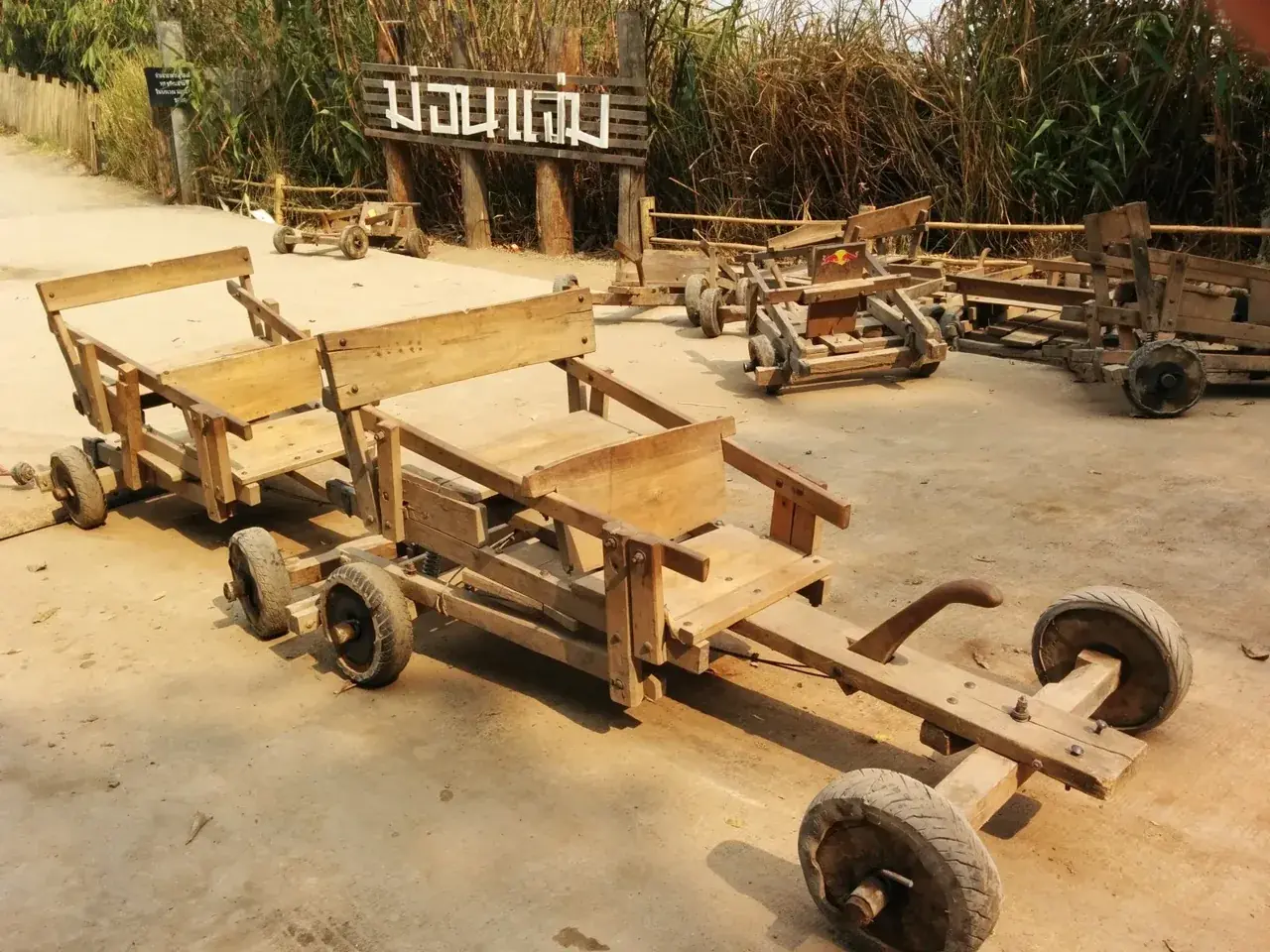
The image at the top of this article is a gravity-powered cart from Mon Jam with primitive brakes. Tourists voluntarily ride these down hillsides at speed. That's a metaphor for Chiang Mai traffic. You're in it whether you chose to be or not. Primitive brakes, chaotic steering, and the hope that everyone else is paying attention. So pay attention to them, adjust to their chaos, and get home alive.
Frequently Asked Questions
Do you drive on the left in Thailand?
Yes. Thailand drives on the left side of the road, the same as Australia, the UK, and Japan. The steering wheel is on the right side of the vehicle.
What is the speed limit in Chiang Mai?
80 km/h on most roads outside the city. 50 km/h within built-up areas. School zones and residential sois (side streets) are lower. Speed cameras and police checkpoints are common on the main roads into the city.
Do I need a Thai driving licence to ride a motorbike in Chiang Mai?
Yes. An international licence or a valid licence from your home country is technically required and can be used short-term, but Thai law requires a Thai licence for longer stays. Police checkpoints check for licences. Riding without one can void your insurance.
Is it safe to rent a motorbike in Chiang Mai as a foreigner?
It can be. The roads are manageable for experienced riders. The main risks are other vehicles, potholes, and poor road conditions at night. Wear a helmet at all times. Hospital treatment for motorbike injuries is a common outcome for unprepared riders.
What happens if I have a motorbike accident in Chiang Mai?
Seek medical attention first. Call the police if required (191). Contact your insurance company. Do not leave the scene or move the vehicles until police arrive if there is a dispute. See the guide on what to do after a vehicle accident for the full process.
Guru Tip
At traffic lights in Chiang Mai, vehicles turning left are often permitted to proceed without waiting for a green light. This applies to most standard intersections but not all. Watch what local drivers do before assuming it applies. The motorbike lane on the left side of major roads fills quickly. Position yourself early and let larger vehicles move ahead rather than weaving between them.