What Is DTV Visa
DTV stands for "Destination Thailand Visa." It's a relatively new long-stay visa category specifically designed for remote workers, digital nomads, and freelancers who earn income from outside Thailand but live in Thailand.
Unlike ED visa (which requires study) or Retirement visa (which requires age 50+ and savings), DTV only requires proof of income. You can work remotely, freelance for international clients, or run your own online business as long as your income meets the threshold.
Who Qualifies for DTV Visa
Remote Workers
Employees working remotely for companies outside Thailand. Must provide employment letter and recent payslips showing 40,000 THB+ monthly income.
Digital Nomads
Freelancers working for multiple clients. Must provide evidence of income: contracts, invoices, bank statements showing regular deposits from international clients.
Entrepreneurs & Business Owners
Running an online business that generates international revenue. Must provide business registration and bank statements showing consistent income.
Investors & Consultants
Those earning income from investments or consulting work. Documentation varies but must show regular income flow.
Quick Facts
| Detail | DTV Visa |
|---|---|
| Initial Duration | 180 days |
| Extension Possible | Yes, another 180 days (total 1 year) |
| Annual Renewal | Yes, renewable indefinitely |
| Monthly Income Requirement | 40,000 THB (approximately USD 1,200) |
| Visa Cost | Free (no application fee) |
| Income Requirement Check | At time of application only (not verified monthly) |
| Work Restrictions | Can only work remotely for non-Thai employers |
Income Requirements
Proof of 40,000 THB Monthly Income
You must demonstrate monthly income of at least 40,000 THB (approximately USD 1,200 or AUD 2,000). This is checked at the time of application and extension, not continuously monitored.
Acceptable Documentation
- Employees: Employment contract, offer letter, recent payslips (2-3 months)
- Freelancers: Contracts with clients, invoices, bank statements showing deposits
- Business owners: Business registration, tax returns, bank statements
- Investors: Investment account statements, dividend records, portfolio documentation
Cost Breakdown
| Item | Cost (THB) | Notes |
|---|---|---|
| Initial DTV Application | 0 | Free. No visa fee. |
| Extension (180 more days) | 0 | Free. No extension fee. |
| Annual Renewal | 0 | Free. Indefinite renewals. |
| TM.30 (address notification) | 0 | Free if done yourself online or in person. |
| Visa Agent (optional) | 3,000-5,000 | Only if using an agent to handle application. |
Application Process
Step 1: Gather Required Documents
- Passport (valid at least 6 months)
- Passport copies (data page + recent stamps)
- TM.6 application form (from Immigration)
- 4x6cm passport photos (4 copies)
- Proof of income (employment letter, contracts, bank statements, tax returns)
- Proof of accommodation in Thailand (lease, hotel booking, property certificate)
Step 2: Submit at Thai Immigration
Visit your local Immigration office with complete documents. In Chiang Mai: 71 M.3 Airport Road. Processing time: 3-5 days. Cost: Free.
Step 3: Receive Your 180-Day Permission
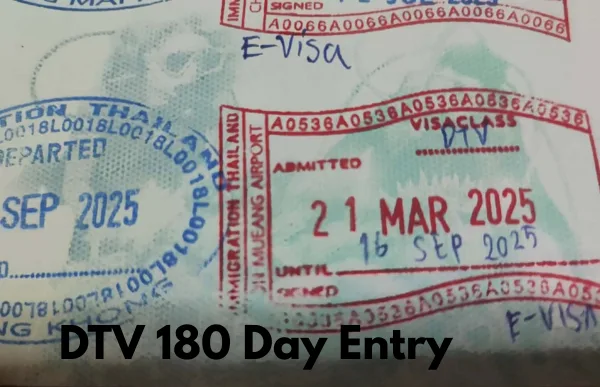
You'll receive a TM.47 stamp granting 180 days DTV permission. Keep this document safe. This is not in your passport; it's a separate document.
Step 4: Extension (Optional, at 180-Day Mark)
Before your 180 days expire, you can apply for extension of another 180 days using the same process. This gives you up to 1 year on your first DTV issuance.
Renewal Process
After 1 year expires, you can renew your DTV by applying the same way you did initially. You'll need to re-submit proof of current income (payslips, bank statements, contracts). If your income still meets the 40,000 THB threshold, renewal is straightforward.
Unlike ED visa, there's no attendance requirement. DTV renewal is purely about income verification. Once approved, you can live anywhere in Thailand and do whatever you want (as long as you don't work for Thai employers).
DTV Visa vs. Other Long-Stay Options
How does DTV compare to alternatives?
- ED Visa: No income required, but you must study. DTV better if you don't want to study.
- Retirement Visa: Requires age 50+ and 800,000 THB savings. DTV better if under 50 or don't have savings.
- Marriage Visa: Requires married to Thai national. DTV simpler if not married.
For remote workers and digital nomads with consistent income, DTV is the best fit. No study commitment, no age requirement, no large savings needed.
Pros and Cons
Pros
- No study or training commitment required
- No age restrictions (works for any age)
- No large savings requirement (just income proof)
- 180-day initial grant plus 180-day extension (1 year total)
- Renewable indefinitely
- Completely free (no visa fee)
- Once approved, very flexible (can travel, work from anywhere)
Cons
- Must prove 40,000 THB monthly income
- Income requirement re-verified at extension and renewal
- Cannot work for Thai employers
- Initial 180-day grant only (must extend to get full year)
- Documentation requirements stricter than ED visa
Key Takeaways
- DTV visa: 180-day initial for remote workers with 40,000+ THB monthly income. Extendable to 1 year, renewable annually.
- No study requirement, no age restriction, no large savings needed. Income documentation only.
- Perfect transition visa after ED visa year. Many people do ED year one, then switch to DTV for years 2+.
- Completely free. No visa fee, no extension fee, no renewal fee. Just immigration processing time.
- Once approved, very flexible. Can work remotely from anywhere in Thailand. No attendance tracking or requirements.
- Check CMLocals.com/dtv-visa for official requirements before applying.
Ready to apply? Full step-by-step guide, document checklist, and current processing times at CMLocals: DTV Visa Guide.
Guru Tip
The DTV visa requires a Thai consulate application. Do not attempt to apply at the border or at immigration offices inside Thailand. The best consulates for straightforward processing in 2026 are Kuala Lumpur and Singapore, both with predictable processing times and English-language competence at the counter. Apply in person rather than using an agent if you can manage the travel, as agents add cost and an additional layer of document handling that creates potential for errors.
What is the DTV visa Thailand?
The Destination Thailand Visa (DTV) is a 5-year multiple-entry visa designed for remote workers, digital nomads, freelancers, and those pursuing soft power activities. Each entry grants 180 days, extendable once for another 180 days at local immigration. It requires proof of 500,000 THB in savings and evidence of remote work or qualifying activity.
Who qualifies for the DTV visa?
Remote workers with foreign income, digital nomads, freelancers, artists, sports practitioners, and those enrolled in Thai language or cultural programs. You must not receive income from Thai sources. The 500,000 THB savings requirement (roughly $20,000 AUD or $14,000 USD as of 2026) is the main financial bar.
Can I work in Thailand on a DTV visa?
You can work remotely for overseas clients or employers. You cannot work for Thai companies or receive payment from Thai sources. You also cannot work in Thailand as an employee without a separate work permit. The DTV is a stay permission, not a work authorisation for local employment.
How long can I stay in Thailand on a DTV visa?
Each entry grants 180 days. You can extend once at local immigration for another 180 days, giving a potential 360-day continuous stay. After that you must exit and re-enter to get a fresh 180-day grant. The visa itself is valid for 5 years from issue, so multiple entries are available across the visa lifespan.
Where do I apply for the DTV visa?
At a Thai embassy or consulate outside Thailand. You cannot convert to DTV from inside Thailand. Kuala Lumpur and Singapore are popular choices for Chiang Mai-based residents due to flight frequency and consulate reliability. Processing time varies but typically runs 1 to 3 business days for in-person applications.