The Most Expensive Mistake You Can Make Before You Arrive
I have watched people arrive in Chiang Mai having pre-paid three months' rent on a condo they found on Airbnb, only to discover the unit is directly above a bar with live music until 1 AM, or that the listed "5-minute walk to Nimman" is actually a 25-minute walk in June heat. The Chiang Mai rental market punishes remote decision-making. It rewards people who are physically present. This guide is the framework I would give any friend arriving for the first time.
The 6-Day Landing Pad: Your First Week in Chiang Mai
The logic is simple. Chiang Mai has a high-turnover rental market with low digital visibility. The landlords with the best properties, the cleanest maintenance records, and the most reasonable contracts do not list on major booking platforms. They lose 10-15% of a month's rent in commission fees every time they do. Instead, they put a yellow or red "For Rent" sign on their gate, tell the neighbours, and wait. These are the units you cannot find from your laptop in London or Sydney.
Book a landing pad: a short-stay hotel, hostel, or serviced apartment for 4-6 nights in or near your target neighbourhood. Use those days to walk the sois (side streets), knock on gates, and negotiate from a position of physical presence. The formula works because landlords in Chiang Mai are deeply practical. A confirmed tenant with a deposit in hand on a Thursday afternoon is worth more than a theoretical tenant who might arrive next month.
The 6-Day Schedule
- Days 1-2: Recover from jet lag. Get a local SIM card (AIS or True 5G are the reliable picks). Rent a scooter from a reputable shop or use LOMO EV Tuk-Tuks for short hops. Eat well. Walk slowly. Get oriented.
- Days 3-4: Walk the sois in your target neighbourhood. Look for yellow and red "For Rent" signs on gates and fences. Take photos. Note the soi number (it matters at 2 AM). Knock. Chat. Do not commit to anything yet.
- Days 5-6: Revisit your top three or four properties. View them at different times of day. Check the mattress, the water pressure, the Wi-Fi speed. Then use your leverage: "I am here, I have cash, I can sign today. What is your real price?"
Most landlords will discount 15-25% off whatever they quoted online or on the sign. That is not a negotiating trick. That is simply the Chiang Mai market functioning as it always has. The internet price includes a margin for uncertainty. Certainty is worth a discount.
Neighbourhood Guide: Finding Your Purpose District
Chiang Mai is not one city. It is six or seven distinct towns that happen to share a moat and a mountain. Choosing the wrong neighbourhood for your situation is the second most common mistake, after pre-booking. Here is the honest breakdown of each area as of 2026.
---Old City
The Old City is the square kilometre surrounded by the historic moat. It is the most photographed part of Chiang Mai and the most walkable. Wats (temples) on every corner. Night markets on weekends. The Saturday Night Market runs down Wualai Road; the Sunday Walking Street fills the entire length of Tha Phae Road. If you have never been to Chiang Mai, this is a logical starting point for your landing pad stay.
The honest trade-off: the Old City is increasingly tourist-facing. Rents reflect that. You will pay more per square metre here than in Santitham for a noticeably older building. Street noise, particularly around the eastern gate area (Tha Phae), is real on weekend nights. It is not a place most long-term residents choose once they know the city.
That said, for the right person, particularly someone who wants temples, walking, and cultural immersion as daily life, nowhere else compares.
Full Old City neighbourhood guideNimman
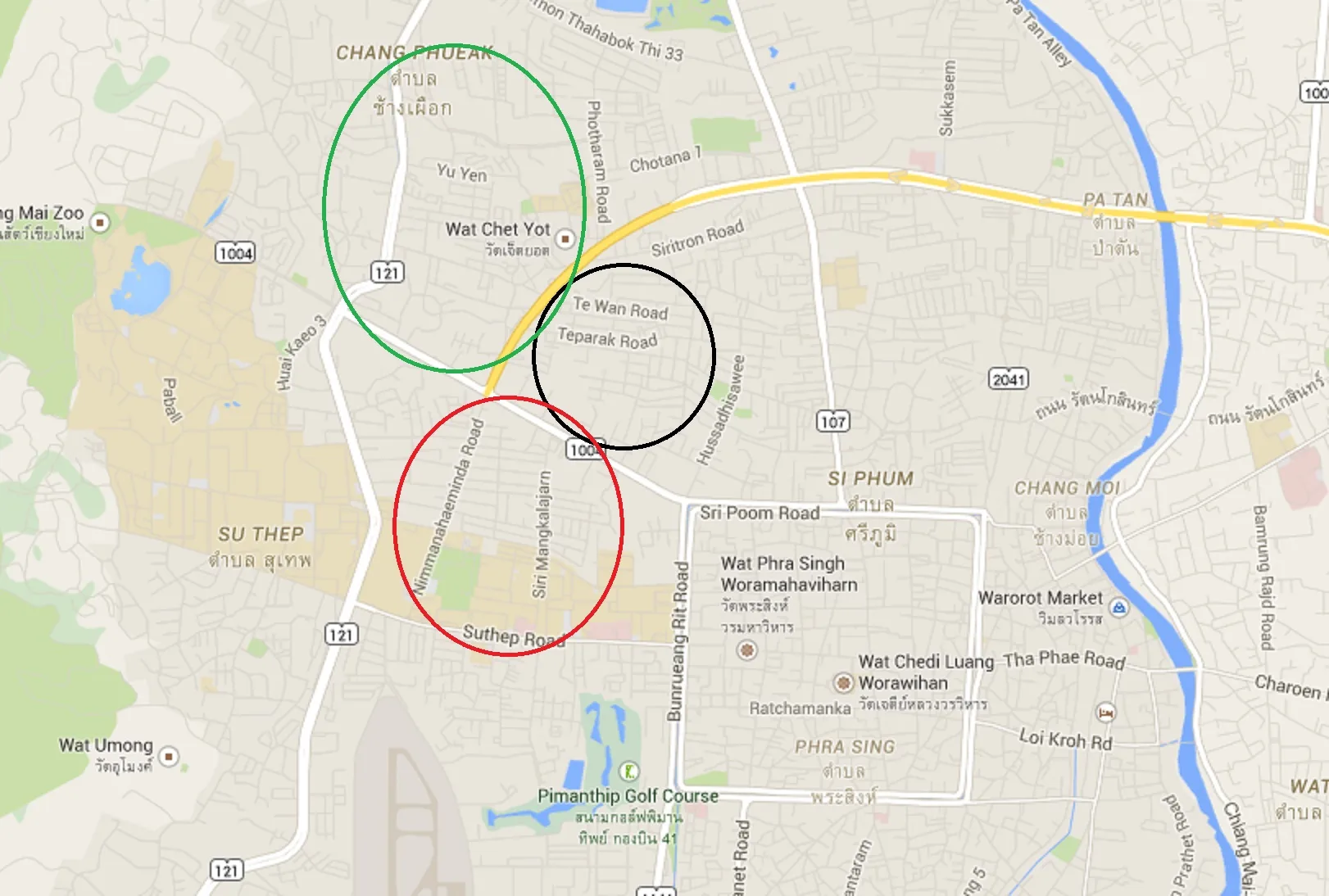
Nimman (short for Nimmanhaemin Road) is Chiang Mai's answer to Bangkok's Thong Lo. Specialty coffee, co-working spaces, boutique hotels, and rooftop bars dominate the main road. Maya Mall anchors the northern end. The Nimman market runs on weekends. The digital nomad density is the highest in the city.
The noise situation is worth knowing before you commit. The sois off the main road vary dramatically. Soi 1 is calmer. Soi 7 through 9 are bar-adjacent and loud on Friday and Saturday nights until 1-2 AM. This is not gossip; this is a floor-plan-level consideration. A condo 50 metres off the main road can be a completely different acoustic experience from one on it.
Rents are the highest in the city for urban living. The 1-bed condo range of 8,000-22,000 THB runs from older side-soi buildings up to premium units with pools, gyms, and concierge. The low end is older stock that typically lacks the building maintenance that newer developments offer. The Wi-Fi infrastructure in Nimman is generally excellent. It was built for nomads.
Full Nimman neighbourhood guideSantitham
Santitham is the neighbourhood I know best. It sits north of the Old City moat, west of the Superhighway, and it is where Chiang Mai's actual residents live alongside the expats who figured out it was the best-value area in the city. The street food is better than Nimman. The density is lower. The sois are quieter. And the price is 40-50% less than comparable Nimman square footage.
The trade-off is that you will need a scooter or a bicycle. Santitham is not walkable to the major amenities of Nimman without a 20-25 minute walk or a short ride. The Songthaew (red truck shared taxi, 30 THB flat rate within the city) runs along the main roads but not deep into the sois. Once you have your own transport, this ceases to be an issue.
The "hidden inventory" phenomenon is strongest here. Walk Soi Santitham 1 through 5 on a quiet Tuesday morning and count the For Rent signs. You will find guesthouses, converted townhouses, and older condos that never appear on any aggregator site. These are the deals.
Full Santitham neighbourhood guideJed Yod
Jed Yod sits north of Santitham, close to Chiang Mai University's northern edge and the Superhighway. The name comes from Wat Jet Yot, the 15th-century temple with seven spires that anchors the area. It is one of Chiang Mai's quietest residential zones. Green, shaded, genuinely local. The night market on the university ring road is one of the city's best-kept food secrets.
Rent here is the most affordable of any accessible urban neighbourhood. The 6,000-10,000 THB range gets you a furnished studio or a basic one-bedroom with a landlord who has typically owned the building for decades. These are not luxury units. They are clean, functional, and honest. For anyone on a genuine budget who still wants to be within the city rather than commuting from the suburbs, Jed Yod is the answer.
The student proximity means there is a reasonable density of cheap food, copy shops, and minor repair services. It also means that during CMU term time, the area gets louder. Plan around that if quiet is a non-negotiable.
Full Jed Yod neighbourhood guideHang Dong and Mae Hia
Hang Dong is where Chiang Mai's international family community has quietly settled over the past decade. It sits 10-15 kilometres south of the city centre on the way to the airport. Mae Hia is the adjacent district. Together they form the primary zone for families with children in international schools.
The schools that anchor the area include Panyaden International School and Grace International School. The "school run" traffic is worth road-testing before you sign a lease. During term time, the main Hang Dong road between 7:30 and 8:15 AM is backed up. It is not Bangkok-level gridlock, but it is real and it is daily. Visiting a potential rental on a school morning is not paranoia. It is due diligence.
The rental product here is fundamentally different from the city. You are looking at 3-4 bedroom Lanna-style houses with gardens, parking, and often a pool. At 25,000-45,000 THB per month you get a family home, not a condo. The same money in Nimman buys a 1-bedroom apartment.
Full Hang Dong neighbourhood guideWat Ket and the Riverside
The Riverside area, anchored by the Ping River, is Chiang Mai at its most atmospheric. Former teak merchant houses converted into boutique hotels, art galleries in old warehouses, and the quiet that comes from being slightly east of the tourist centre. The Riverside is a neighbourhood for people who have been to Chiang Mai before and want something different.
Wat Ket is the specific sub-district that gives the area its name. The Sunday market here is smaller and more locally oriented than the Old City walking street. The food scene is strong in the afternoon market that sets up along the river road. Rents are mid-range and the inventory is genuinely varied, from renovated heritage houses to modern riverside apartments.
Full Wat Ket and Riverside guideThe Hidden Inventory: Why the Best Rentals Are Invisible Online
The Chiang Mai rental market operates on a high-turnover, low-digital-visibility model. Understand this and you unlock the best deals. Misunderstand it and you pay 20-30% over market rate for the privilege of convenience.
Here is the structure. Major listing platforms (Airbnb, Booking.com, Fazwaz, DDproperty) charge landlords 10-15% commission per booking or listing fees that add up over a year. A landlord with a desirable unit in Santitham or Chang Phueak knows their property rents itself through word of mouth and walk-in traffic. They use platforms only as a last resort, and when they do, they price up to recoup the commission. The unit you find on a platform is the same unit, at a higher price, that you could have found by walking the soi.
The Negotiation Arithmetic
The negotiation gap works like this: if a unit is listed online at 15,000 THB per month, the landlord's actual target is closer to 12,000-13,000 THB. They have built in a margin for platform fees, for remote tenants who might cancel, and for the general uncertainty of not knowing who will move in. When you show up in person with your deposit ready and a visa that demonstrates you are staying long-term, you collapse that uncertainty entirely.
The DTV (Destination Thailand Visa) is particularly powerful here (as of 2026, it requires proof of 500,000 THB in savings and provides 5-year multi-entry, see CMLocals' DTV visa guide for the full requirements). Landlords have learned, through experience, that DTV holders stay for 6-12 months at a stretch. That predictability is worth a discount. The same applies to Non-O Retirement Visa holders. Stability has a price in reverse: the stable tenant pays less.
Note on TM30 filing: your landlord is legally required to report your stay to immigration within 24 hours of your arrival via the TM30 form. Most landlords in 2026 handle this online. They will ask for your TDAC (Thailand Digital Arrival Card) QR code, which you should have completed before landing at CNX. Have it ready on your phone.
What You Cannot Check Online
Every experienced Chiang Mai resident has a story about an apartment that looked perfect in photographs and turned out to be adjacent to a problem that no Booking.com listing will ever disclose. Here is the checklist for your in-person visit.
- 4 AM temple bells: Chiang Mai has more than 300 active temples. Many conduct morning merit-making chants between 4 and 6 AM using PA systems. You cannot hear this in a Booking.com review.
- Soi noise levels at night: Walk the street at 10 PM on a Friday. A quiet soi at 11 AM is not evidence of anything.
- Construction proximity: Chiang Mai is building. The new mixed-use developments along the Superhighway ring road mean that what is a quiet field today could be a construction site in 6 months. Ask the existing tenants.
- Water pressure: Older buildings in the Old City and Santitham have variable water systems. Run the shower and fill the sink simultaneously during your viewing.
- Wi-Fi infrastructure: Ask for a speed test in the unit itself, not from the lobby. Building construction (concrete, reinforcement) affects signal dramatically floor by floor.
- Flood history: Low-lying sois near the Ping River and in certain parts of the Old City can flood during the rainy season (June-October). Ask directly. Landlords will not volunteer this.
The Landing Pad Shortlist: Where to Stay for Your First 6 Days
Your landing pad is a tactical decision, not a luxury decision. Stay in the neighbourhood you are most seriously considering. Walking distance to your hunting ground is worth paying for.
The Heritage Pick
Tamarind Village (Old City). One of the most considered hotels in the city, built around a 200-year-old tamarind tree on Ratchadamnoen Road. If you are considering the Old City or anywhere nearby, staying here gives you the genuine character of the area while you assess whether you can live with the weekend market noise. The price reflects the quality: expect 3,000-5,000 THB per night.
The Nomad Pick
Hub53 or Alt ChiangMai, both in the Nimman orbit. These properties are designed around the working nomad: fast Wi-Fi, social spaces, daily cleaning, and a front desk that actually knows which sois to walk for rental hunting. You will meet people on your first morning who can tell you which condos in the area have reliable internet and which buildings have management issues. This intel is worth the room rate.
The Budget Pick
The Common Hostel (private room). Central, clean, and full of people who arrived two weeks before you and have already done the work. Budget hostel communities in Chiang Mai function as informal intelligence networks. The person in the common room at 9 PM who just found a 9,000 THB Santitham studio is the most useful person in the city for your purposes.
Specialist Notes: Family, Retiree, and Visa Considerations
For Families
If you are moving with children, your decision-making starts with schools, not neighbourhoods. Panyaden International School is Montessori-based, located in Hang Dong, and has a waiting list. Grace International School serves a broader age range and is also south of the city. Once you know which school your children are attending, map the commute radius and then choose your rental within it. The school run traffic on the Hang Dong road is manageable if you are within 3-4 kilometres. It is not manageable if you are attempting it from Nimman every morning.
For family accommodation, the 25,000-45,000 THB range in Hang Dong and Mae Hia delivers a 3-bedroom house with a garden that would cost three times as much in Bangkok. Use the 6-day landing pad at a property like North Hill City Resort while you do school visits and road-test the commute. See our full guide to moving to Chiang Mai with a checklist for the complete process.
For Retirees
The Non-O Retirement Visa requires 800,000 THB (~$33,000 AUD as of 2026) in a Thai bank account, or a combination of income and savings that meets the threshold. Verify current requirements with a reputable immigration advisor before arriving, as the rules have tightened periodically. The LTR Wealthy Pensioner visa is the premium alternative for those with pension income above the threshold and assets to match. It provides a 10-year stay and a more streamlined process. My free Ultimate Chiang Mai Retirement Guide covers the housing side of this in more depth, no email required.
For accommodation, do not default to a Nimman condo because it is what you see advertised. The Lanna-style teak houses available in San Sai and Mae Rim (north of the city, quieter, greener) offer garden space, genuine Thai architecture, and a residential pace that suits long-term living. You get more outdoor space for the same money as a small Nimman studio. The critical constraint for retirees is hospital proximity. Ensure any rental you consider is within a 15-minute drive of Bangkok Hospital Chiang Mai or Chiang Mai Ram Hospital. Check our guide to Chiang Mai medical services for the full breakdown.
Visa Leverage in Rental Negotiations
Your visa status is a negotiating asset that most newcomers forget to use. The hierarchy, from a landlord's perspective, looks roughly like this:
- DTV (Destination Thailand Visa): 5-year, multi-entry. Landlords see this as maximum stability. Use it explicitly in your negotiation.
- Non-O Retirement or Marriage Visa: Annual renewal but well understood by landlords. Strong stability signal.
- LTR Visa: 10-year, premium signal. Most landlords have not seen many of these yet but respond positively.
- ED Visa: Reliable but shorter-term in perception. Good signal for smaller studios near language schools.
- Tourist visa or visa exemption: Weakest negotiating position. Landlords know you may leave in 30-60 days. Price accordingly or commit to a longer term in writing.
For more on visa options and their practical implications for Chiang Mai life, see our DTV Visa guide and Thai visa advice overview.
The Rental Cost Breakdown: What You Actually Pay
The monthly rent figure is not your total housing cost. Here is the honest accounting for a typical Chiang Mai rental as of 2026.
| Cost Item | Nimman 1-bed | Santitham 1-bed | Hang Dong 3-bed |
|---|---|---|---|
| Monthly rent | 18,000 THB | 11,000 THB | 30,000 THB |
| Electricity (metered) | 800-1,500 THB | 600-1,200 THB | 1,500-3,000 THB |
| Water | 150-300 THB | 100-200 THB | 200-400 THB |
| Internet (if not included) | 500-700 THB | 500-700 THB | 500-700 THB |
| Typical monthly total | ~20,000 THB | ~13,000 THB | ~32,500 THB |
Electricity in Thailand is metered at a "residential rate" for individual houses and a higher "commercial rate" for condos and apartments where the building buys in bulk and resells. Always ask which rate applies. The difference between 4 THB per unit and 8 THB per unit is significant over a hot-season month when you run air conditioning continuously.
For the full picture of what life actually costs month to month, including food, transport, health insurance, and entertainment, see our detailed Chiang Mai cost of living guide.
Getting Around Once You Have Moved In
Accommodation and transport are inseparable decisions in Chiang Mai. The city has no metro, no BTS equivalent, and limited public bus coverage. Your mobility options, in order of practicality, are:
- Scooter or motorbike: The default for most residents. Inexpensive to rent long-term (2,500-4,000 THB per month), covers all terrain, and parks anywhere. See our motorbike rental guide and ensure you have a valid International Driving Permit or a Thai licence. Read the road rules guide before you ride.
- Songthaew (red truck): Chiang Mai's shared taxi system. 30 THB flat rate within the city for a shared ride. Wave one down, state your destination, and the driver will either nod (going that way) or shake their head (not going that way). Private charter is negotiable. See the full Chiang Mai transport guide.
- LOMO EV Tuk-Tuks: The 2026 addition to the city's short-hop options. Electric, air-conditioned, app-based. Good for distances too far to walk but too short to justify a Grab.
- Grab, Bolt, Maxim: App-based fixed-price rides. Always compare all three before confirming. Surge pricing varies between platforms at peak hours.
Key Takeaways
The Chiang Mai rental market rewards presence and punishes remote decision-making. The 6-day landing pad strategy is not just a tactic for saving money. It is the only way to make a fully informed decision about where you are going to live. Book your landing pad, get on the ground, walk the sois, and negotiate from a position of certainty. The right neighbourhood, the right unit, and the right price are all available to you if you are there in person.
If you are planning your move in full, do not miss our complete Chiang Mai moving checklist or the planning your move to Thailand guide.
Frequently Asked Questions
How much is rent in Chiang Mai in 2026?
It depends entirely on the neighbourhood and unit type. Budget studios in Santitham or Jed Yod start from 6,000-8,000 THB per month. A comfortable 1-bedroom in Nimman runs 8,000-22,000 THB. A 3-bedroom family house in Hang Dong is 25,000-45,000 THB. All prices are for direct landlord deals. Add 15-20% if booking through platforms.
Which neighbourhood in Chiang Mai is best for digital nomads?
Nimman is the default answer and it earns it. The Wi-Fi infrastructure is built for remote work, co-working spaces are abundant, and the social scene is active. Santitham is the better-value alternative: quieter, cheaper, good street food, and close enough to Nimman by scooter that you get both worlds.
Can foreigners rent apartments in Chiang Mai without issue?
Yes. Most landlords are experienced with foreign tenants and handle TM30 immigration reporting routinely. You will need your passport, your visa documentation, and ideally a TDAC QR code from your arrival. Some landlords ask for a 1-2 month deposit. Contracts are typically in Thai; ask for an English version or have it translated before signing.
How long should I stay in a landing pad before signing a lease?
Four to six days is enough if you are focused. Use days 1-2 to orient, days 3-4 to walk sois and view properties, days 5-6 to revisit your top choices and negotiate. Do not rush the process. A wrong decision costs you three months of misery and the hassle of moving again.
Is Airbnb good for finding long-term rentals in Chiang Mai?
It is useful for landing pad stays of 1-2 weeks while you search. It is a poor tool for finding your actual long-term rental. The best units never appear on Airbnb. They are found by walking the sois in your target neighbourhood and knocking on gates. The savings from cutting out the platform are significant.
What is a TM30 and does my landlord need to file it?
TM30 is an immigration form that property owners are legally required to file within 24 hours of a foreign national staying at their property. Most landlords in Chiang Mai handle this online and are familiar with the process. They will ask for your TDAC (Thailand Digital Arrival Card) QR code on arrival. If your landlord does not know what TM30 is, that is a red flag for how they handle their legal obligations generally.
Guru Tip
- Never sign a lease on a Monday. The city is too busy and landlords are distracted. Visit your shortlisted properties on a Saturday night: if you can tolerate the noise and the Sunday market crowds on Tha Phae Road, you have found your neighbourhood. If you cannot, you have saved yourself three months of misery.
- The Santitham morning market on Soi 1 (open 6-10 AM daily) is your most accurate quality-of-life indicator for that neighbourhood. If the market is clean, the vendors are regulars, and the price of a Khao Tom (rice porridge, 40 THB Farang price, 25 THB local price) is fair, the neighbourhood management is working. A chaotic market means a chaotic soi at midnight.
- Ask your potential landlord directly: "Has this unit ever had water damage during rainy season?" The legal obligation to disclose varies. The moral obligation does not. Watch the reaction as much as the answer.